
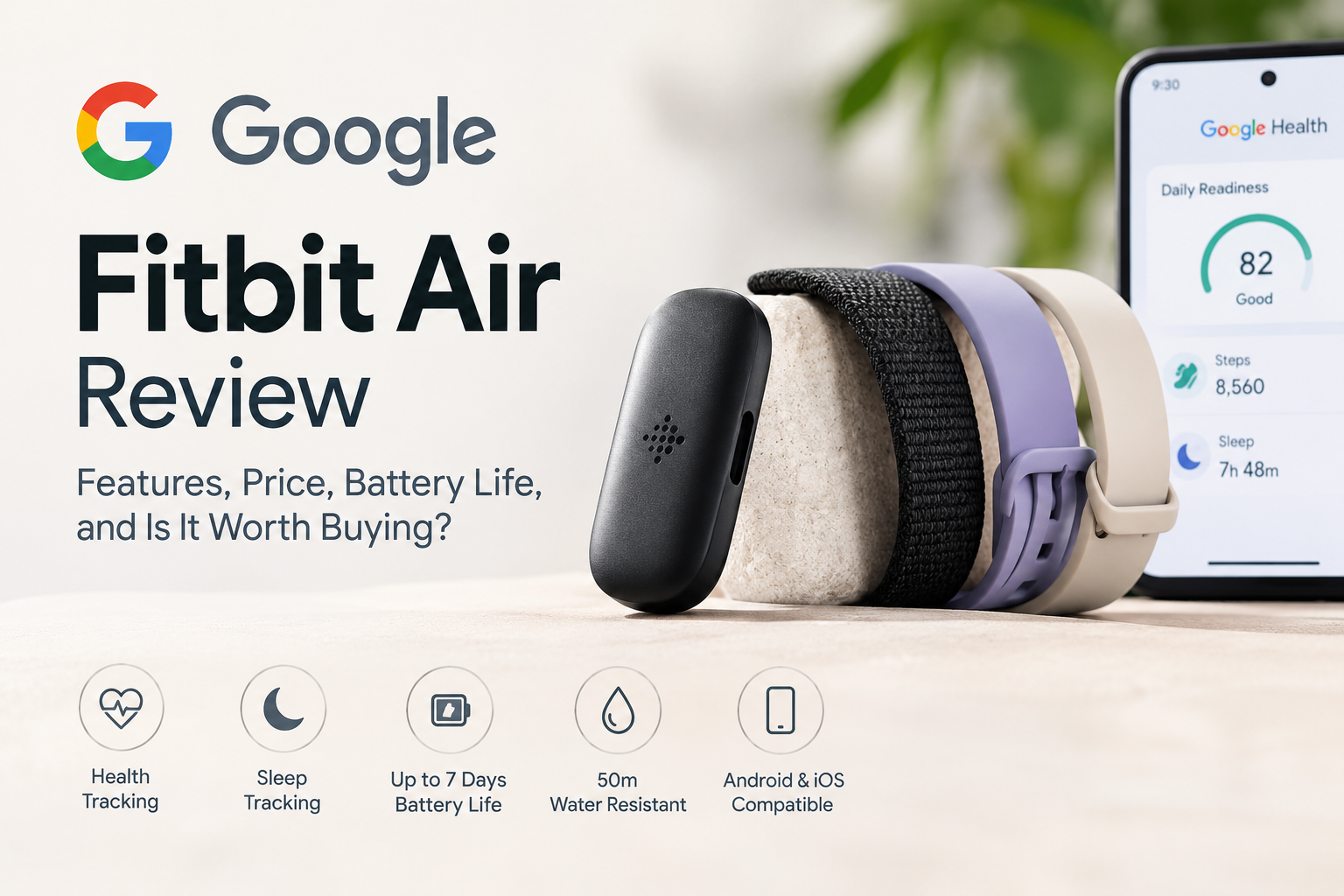
Google Fitbit Air Review (2026) | Battery, Price, Limits and Who It’s For
Google Fitbit Air is a lightweight, screenless fitness tracker designed to monitor daily activity, heart rate, sleep, and selected wellness measurements without the distractions of a traditional smartwatch. Announced by Google on May 7, 2026, the wearable combines a minimalist design with the Google Health app and optional AI-powered coaching through Google Health Premium.
Google Fitbit Air is a $99.99 screenless fitness band that tracks heart rate, sleep and daily activity, then shows everything in the Google Health app. It lasts about seven days per charge and works with Android phones and iPhones. It has no display and no built-in GPS, and its Gemini-powered coach needs a paid Google Health Premium plan once the three-month trial ends. It suits people who want quiet, low-effort tracking. It is a weak fit for runners who want to leave their phone at home.
Fitbit Air at a glance
| Spec | Details |
|---|---|
| Type | Screenless fitness tracker with a status light |
| Announced / shipped | May 2026 / late May 2026 |
| US price | $99.99 (special edition $129.99) |
| Weight | 5.2 g tracker, about 12 g with the standard band |
| Battery | Up to 7 days; about 90 minutes for a full charge |
| Water resistance | Up to 50 meters |
| Connectivity | Bluetooth 5.0 |
| Sensors | Optical heart rate, red and infrared SpO2, temperature, accelerometer, gyroscope |
| Phone support | Android 11 or newer, iOS 16.4 or newer (per Google) |
| App | Google Health (the renamed Fitbit app) |
| Free trial | 3 months of Google Health Premium with purchase |
What is Fitbit Air?
Fitbit Air is Google’s first fitness band with no display. A small tracker unit, about the size of a puck, clicks into a fabric or silicone band. Instead of showing your heart rate or step count on your wrist, it sends the data to your phone, where the Google Health app turns it into daily summaries, sleep reports and training suggestions.
Google launched it alongside a bigger change: the Fitbit app was renamed Google Health, and Fitbit Premium became Google Health Premium with a Gemini-based coach. Because of that, Fitbit Air is aimed at the same buyers as Whoop and the Amazfit Helio Strap: people who want health data without a smartwatch on their wrist.
How this guide was researched
This guide is based on Google’s published specifications, launch coverage from several tech outlets, and the detailed hands-on review published by Thurrott.com in June 2026. Where a finding comes from one reviewer’s experience, the text says so. Prices and features are checked against sources dated through October 2026, and the page is updated when Google changes them.
Design, fit and daily wear
At 5.2 grams, the tracker is light enough that one hands-on reviewer wore it through the night for sleep tracking without discomfort. The default Performance Loop band is made of recycled polyester and elastane and comes in four colors: Obsidian, Berry, Lavender and Fog. Silicone and polyurethane bands are sold separately, and they were reportedly out of stock for a while after launch.
Some design choices are unusual:
- No power button.
The tracker only switches off when its battery runs flat. - Double-tap control.
Tapping the band twice dismisses a vibrating alarm and shows the status light. - Status light.
White means more than 20% battery, blinking red means below 20%, and solid red means empty. - Proprietary magnetic charger.
You cannot use a standard USB cable alone, so keep the charger somewhere safe.
Water resistance is rated to 50 meters, so showers and rain are fine. Google advises drying the band after it gets wet, and washing it now and then is good for your skin.
What does Fitbit Air track?
Fitbit Air covers the usual wellness basics. None of it is medical-grade, and Google does not position the band as a medical device.
| Metric | What you get | What to know |
|---|---|---|
| Heart rate | All-day readings, stored every 2 seconds | Needs a snug fit; wrist sensors drift during hard movement |
| Heart rhythm | Alerts for irregular rhythm | A prompt to see a doctor, not a diagnosis; availability varies by country |
| Blood oxygen (SpO2) | Estimates from red and infrared sensors | Best for trends, not for medical decisions |
| Sleep | Duration and stages, with a summary after waking | Detailed AI insights need Premium |
| HRV and breathing rate | Recovery context | Need at least one full day of wear |
| Skin temperature | Nightly variation | Needs about 3 nights of data to appear |
| Daily Readiness Score | A prompt to push or rest | Needs about 7 nights of sleep data before the first score |
| Steps, calories, distance | Daily totals | Distance and floors rely on your phone |
If the band cannot reach your phone, it keeps daily totals for up to 30 days and syncs them later.
Does Fitbit Air have GPS?
No. Fitbit Air has no built-in GPS. Distance, routes and floors climbed come from your phone’s GPS, so you need to carry the phone for outdoor workouts.
There is a second catch. Workouts the band detects automatically do not include GPS or elevation data. To get a route, you have to start the session manually in the Google Health app. The same applies to VO2 max estimates, which rely on a manually tracked outdoor run with pace and heart rate. Runners and cyclists who like to train phone-free should look at a GPS watch instead.
How good is automatic workout detection?
Automatic detection works best for steady, high-movement activities such as running and cycling. Two limits matter in practice:
- Delay.
A detected workout can take 30 minutes or more to appear in the app. - Mislabeling.
The reviewer at Thurrott found that brisk walks were sometimes logged as runs. Fast walkers should expect to correct entries now and then.
Manual tracking gives better data, but the app’s live tracking is basic. In that review, it lacked lock-screen controls on iPhone and did not pause automatically when the user stopped moving, and voice cues did not work.
How long does the battery last?
Fitbit Air is rated for up to seven days, and the Thurrott reviewer saw about that in real use. A full charge takes around 90 minutes, and a five-minute top-up gives roughly one day. That is far better than most smartwatches, which usually need charging every day or two.
The band’s battery is only half the story, though. On an iPhone, the same reviewer found the Google Health app using about 10% of the phone’s battery per day and running in the background for roughly an hour and a half, even with background refresh turned off. Android results may differ, so check your own battery stats in the first week.
Google Health app and Health Coach: free vs Premium
The tracker works without a subscription, but the experience changes a lot with Premium.
| Free | Google Health Premium | |
|---|---|---|
| App tabs | Today and Health | Adds Fitness and Sleep tabs |
| Core metrics | Heart rate, steps, sleep basics, readiness | Same, with deeper analysis |
| Health Coach (Gemini) | No | Chat coach, weekly plans, sleep summaries, proactive tips |
| Guided content | No | Workout library, meditations, sleep stories |
| Cost | $0 | $9.99 per month or $99.99 per year |
Premium is included at no extra cost with Google AI Pro and Google AI Ultra plans, so existing subscribers may already have it.
The coach asks you a few minutes of questions about your goals, then builds a plan. It can use data you import from Apple Health, adjust for weather and medication you tell it about, and even read medical records if you choose to upload them. Google says it will not replace a doctor and will not train its AI models on your personal data.
The coach also has weak spots. In the Thurrott review it sometimes forgot routine details such as daily walks, occasionally failed to respond, and had a habit of approving whatever the user decided, even after suggesting rest. Treat its advice as a starting point, not a verdict. There is no voice input yet, so you type your questions.
How much does Fitbit Air really cost?
The $99.99 sticker price is only the entry fee.
| Scenario | Approximate first-year cost (USD) |
|---|---|
| Tracker only, free app features | $99.99 |
| Keep Premium after the trial, billed monthly | about $190 |
| Keep Premium after the trial, billed yearly | about $200 |
| Tracker plus an existing Google AI Pro or Ultra plan | $99.99 extra |
Outside the US, final prices vary with import duties, taxes and retailer margins. In India, for example, Google announced a ₹13,999 price. For Pakistan, compare local sellers carefully, ask about warranty coverage, and confirm that the Google Health app works on your phone and account before paying.
Fitbit Air vs a smartwatch vs other screenless bands
| sources | Fitbit Air | Smartwatch (for example Apple Watch SE 3) | Whoop-style band |
|---|---|---|---|
| Screen | None | Yes | None |
| Built-in GPS | No | Yes | Varies by model |
| Battery | About 7 days | Usually 1–2 days | Multi-day |
| Notifications and apps | No | Yes | No |
| Subscription needed to use it | No (optional Premium) | No | Yes for Whoop |
| Best for | Quiet sleep and activity tracking | Everyday use plus workouts | Recovery-focused training |
The Thurrott reviewer, an iPhone user, returned the Fitbit Air and bought an Apple Watch SE 3 instead, mainly because of the app’s battery use and missing iOS features. He still praised the Air’s battery life and the coach concept. Android users may find a different balance.
Problems to know before you buy
- App stability.
The Google Health app crashed on launch several times during one review week. - Missing iPhone features.
At the time of that review there was no home-screen widget, and the app could read from Apple Health but not write back to it. Google said it was working on the second point. - Hard-to-find history.
Workout data older than a week was awkward to locate. - Calibration period.
Several metrics take days to appear, so early numbers can look incomplete. - Estimates, not medical readings.
Treat SpO2, temperature and rhythm alerts as prompts to ask a professional if something worries you.
Who should buy Fitbit Air, and who should skip it
Buy it if you:
- want passive sleep and activity tracking without a screen or constant notifications
- value a week between charges
- are curious about an AI coach and are happy to pay for Premium or already have Google AI Pro
- mostly walk, do gym sessions or take casual exercise
Skip it if you:
- run or ride outdoors and want GPS without your phone
- need live stats, notifications or apps on your wrist
- dislike subscriptions and want every feature free
- need medical-grade measurements
Verdict
Fitbit Air is a good, inexpensive way to start tracking sleep and everyday activity, and its seven-day battery is a real advantage over smartwatches. Its weak points are the missing GPS, the app’s rough edges on iPhone, and the extra cost of the coach. Buy it if quiet, low-maintenance tracking is what you want. Choose a GPS watch if training data matters more than comfort.
FAQs
What is Google Fitbit Air?
It is a screenless fitness tracker from Google that records heart rate, sleep and activity and shows the data in the Google Health app.
How much does Fitbit Air cost?
The US price is $99.99, with a $129.99 special edition. Premium costs extra after the three-month trial.
How long does the battery last?
Google rates it at up to seven days, and early hands-on use matched that. A full charge takes about 90 minutes.
Does Fitbit Air have GPS?
No. It uses your phone’s GPS, and you must start workouts manually in the app to record routes.
Does Fitbit Air need a subscription?
No for core tracking. The AI coach, guided content and deeper sleep analysis need Google Health Premium.
Does it work with iPhone and Android?
Yes. Google lists support for Android 11 or newer and iOS 16.4 or newer.
Is it waterproof?
It is water-resistant to 50 meters. Dry the band after it gets wet.
Can Fitbit Air replace a smartwatch?
Only if you do not need a screen, notifications or built-in GPS. Many people use it for sleep and a watch for workouts.
Is it good for running?
It records heart rate and manual runs, but without built-in GPS it is better for casual runners who carry a phone.
Is it accurate?
Heart rate and sleep are useful for trends. Automatic workout labels can be wrong, and none of the readings are medical-grade.
Final thoughts
Google Fitbit Air works best as a quiet companion, not as a replacement for a sports watch. Its strengths are easy to name: a light body, about seven days of battery and a $99.99 entry price that undercuts most screenless rivals.
Its weaknesses are just as clear. There is no built-in GPS and no screen, and the app still has rough edges, especially on iPhone. The true cost also includes Google Health Premium if you want the AI coach.
Before buying, ask yourself one thing: do you want data collected in the background, or answers on your wrist? If it is the first, Fitbit Air is a sensible, low-cost way to learn how you sleep and move. If it is the second, a GPS smartwatch will frustrate you less.
Whichever you choose, use the free features for the first few weeks and add Premium only if you find yourself opening the coach every day.




3 Comments